In fine jewellery and luxury accessories, success is increasingly visual. Shoppers expect lifelike renders, immaculate packshots, and aspirational lifestyle scenes long before a product arrives in-store. A new generation of jewellery content creation tool solutions brings studio-grade image production to your desktop, turning sketches, CAD files, or simple product photos into campaign-ready assets. With AI-powered rendering, drag-and-drop studios, and smart editing that understands metals and gemstones, these platforms help artisans, designers, and growing brands accelerate go-to-market while protecting quality. The result is a unified pipeline for e‑commerce, social, and print—without the cost and delays of traditional photoshoots.
What a Modern Jewellery Content Creation Tool Should Do (Beyond Basic Editing)
A true jewellery content creation tool is more than a photo editor. It’s a complete visual production system built around how jewellery is designed, manufactured, and sold. First, it should accept multiple inputs—hand sketches, CAD files like STL/OBJ, or existing product photos—and transform them into studio-grade visuals. That means realistic metal reflections, gemstone dispersion and scintillation, accurate micro-shadows, and controllable surface finishes. Fine-tuned lighting models are essential to make platinum feel cool and mirror-bright, yellow gold warm and luminous, and pavé diamonds dance without looking overprocessed.
Second, it should offer templated scenes for packshots, lifestyle environments, and on-model imagery. Think drag-and-drop studios with pre-built lighting rigs and camera angles that guarantee consistency across an entire catalog. For example, a solitaire ring lineup might use a 3/4 angle with soft-plate lighting and a balanced drop shadow, while a bold chain benefits from a more directional key to emphasize texture. Scene presets minimize setup time and ensure that every product page feels cohesive across colorways and SKUs.
Third, scalability features are non-negotiable. Batch outputs in 2K and 4K, automated background cleanup, and mask-aware retouching enable quick iteration without tedious manual labor. Smart systems can recompose a single product into multiple aspect ratios (square for marketplaces, vertical for social, horizontal for banners) while preserving the hero angle. Colorway generation—changing metal from white to rose gold or swapping gemstones—must happen within the same lighting and camera setup to maintain brand consistency. And with version control, you can keep a clear history as designs evolve from concept to final production.
Finally, the tool should be brand-aware. Style presets capture the look and feel of your house aesthetic: contrast levels, reflection intensity, backdrop tones, and typography for callouts. Asset libraries store surfaces, hand models, prop sets, and matching environments (studio matte, marble slab, velvet tray, boutique counter) so you can pair a new bangle with the exact visual language used for last season’s earrings. The aim is to eliminate fragmented workflows—no more bouncing between retouching apps, 3D suites, and ad hoc color tools—so teams can move from brief to publish in hours, not weeks.
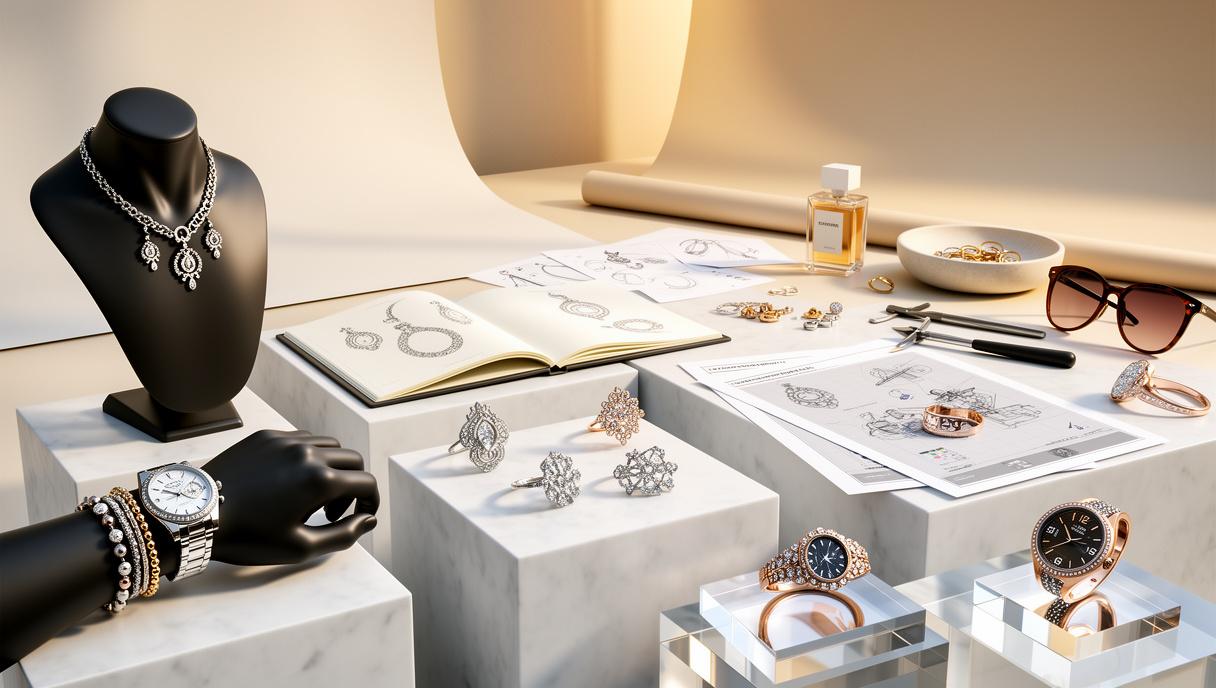
Faster E‑commerce, Social, and Print Workflows Without Compromising Quality
High-performing jewellery imagery is equal parts art and compliance. The best systems build channel requirements into the workflow. For e‑commerce, that starts with razor-sharp packshots on pure white or neutral backdrops, with natural shadows that ground the piece and accurate scale cues for bands, bezels, and bezels. Automated cropping and positioning ensure uniform headroom, center alignment, and perspective across SKUs. Marketplace presets (e.g., square at 2000 px, white background, minimal reflection) and DTC standards (e.g., portrait PDP galleries with 4–6 angles) can be baked into the export stage, reducing costly reworks.
On social, attention wins. Tools that generate on-model imagery with pose variants, skin tone options, and editorial lighting help teams localize looks for different markets while staying on brief. A hoop earring can be styled against a warm afternoon scene for summer, then instantly recontextualized with a cool-toned studio set for winter. Macro-friendly renders spotlight hallmarks, prong settings, knife-edges, or engraving details that spark engagement. Add motion-capable exports or cinemagraph loops to make carousel content feel premium without needing a video crew.
For print and OOH, 4K-ready stills and color-managed exports protect craftsmanship details at large scale. The system should handle CMYK conversions and deliver consistent blacks, whites, and metallic sheens across substrates. Smart denoising preserves the sparkle of stones without muddying facets. Batch naming conventions, embedded metadata, and alt-text fields streamline DAM ingestion and SEO. Most importantly, image fidelity must hold up under zoom—think PDP magnification where customers examine a claw setting or milgrain edge. With a high-performance pipeline, a single master scene can feed thumbnails, detailed zooms, hero banners, and lookbook spreads from the same source of truth.
Speed is only an advantage when it protects authenticity. That’s why best-in-class tools simulate realistic optics, avoid over-smoothing critical micro-geometry, and let you dial in surface imperfections with intent—like a subtle satin finish on a men’s band or a barely-there polishing line on a watch clasp. When production ramps up, batch jobs and cue-based rendering turn overnight windows into content factories, freeing creative teams to focus on storytelling. To see how this looks in action, explore a Jewellery content creation tool designed specifically for luxury products that demand precision at scale.
Real-World Scenarios: From Independent Jewellers to Growing Luxury Brands
Consider an independent goldsmith launching a capsule collection. With only sketches and early CAD, the team needs market-ready visuals to validate demand before investing in full production. A modern jewellery content creation tool can transform line drawings into convincing concept renders, then evolve those into final images as CAD and prototypes mature. Variants—yellow, white, and rose gold; emerald vs. sapphire center stones; pavé vs. plain shanks—are spun up quickly from a shared base scene. The brand collects pre-orders with a polished PDP, social teasers, and a one-sheet for retailers, all built from the same lighting setup and asset library, ensuring zero drift in the look and feel.
Now picture a boutique watch label preparing a hero campaign. Macro realism is critical: brushing direction on lugs, the bevel’s specular roll, crisp dial printing, polished indices, sapphire reflections, and a faithful lume glow. A specialized tool lets art directors choreograph lighting like a real studio—key, fill, and rim lights; flags to tame hotspots; and reflection cards to define metal planes—without the logistical overhead of a physical shoot. Single-scene reuse drives efficiency: the same watch can appear on a granite lifestyle set, a leather strap close-up, and a dark editorial gradient with all reflections and dust control standardized. Retailers receive 2K PDP sets, magazines get 4K masters, and social teams export vertical crops with copy-safe zones for captions and stickers.
For a DTC brand scaling across markets, model diversity and consistency are the battlegrounds. On-model generation makes it easy to showcase pieces across skin tones and hand shapes while preserving canonical angles—ear lobe alignments for studs, wrist curvature for bangles, and neckline fall for chains. Launch calendars become smoother: Valentine’s Day, Eid, Diwali, and Holiday drops can be localized with culturally resonant palettes and styling while maintaining a coherent global brand signature. Performance teams A/B test background brightness, shadow weight, and gemstone hue rendering to see which drives higher CTR and conversion, then save the winners as brand presets.
Collaboration improves too. Merchandisers flag angle gaps, copywriters pull structured metadata for PDPs, and retouchers fine-tune reflections directly in the shared studio rather than passing static files back and forth. When a stone spec changes late—say, switching to lab-grown or upgrading clarity—the master asset updates everywhere, keeping PDPs, ads, and print collateral in sync. Quality control is predictable: every output inherits the same measured lighting model, material definitions, and export settings. The brand scales content without bloating spend, meeting the modern bar for luxury imagery—crisp, consistent, and irresistibly shoppable—week in, week out.

Harare jazz saxophonist turned Nairobi agri-tech evangelist. Julian’s articles hop from drone crop-mapping to Miles Davis deep dives, sprinkled with Shona proverbs. He restores vintage radios on weekends and mentors student coders in township hubs.